Empowering Ocean Sole Mamaz Through Microenterprise and Entrepreneurship
There is a particular kind of energy that comes from a room full of women sharing ideas. Pens move across paper. Questions lead to conversations. Business ideas are discussed, challenged and developed. Women who already know how to create beautiful things with their hands begin looking at their work through a different lens: not only as makers, but as entrepreneurs.
Recently, the Ocean Sole Mamaz came together for entrepreneurship training organised with Microenterprise Social Entrepreneurship (MESENow). Professor Ezenwayi introduced the training, with Omar translating for the Mamaz, before the women began working together on the practical skills behind building and sustaining a small business.
Before we share more, we want to give a huge thank you to Collette, whose support helped make this opportunity possible. Creating space for women to learn, ask questions and develop their own ideas is an investment that can continue making a difference long after the workshop itself has ended. We are incredibly grateful to Collette, Microenterprise Social Entrepreneurship (MESENow), and everyone who gave their time and knowledge to the Mamaz.
Because this training wasn't about telling the women what to create. It was about giving them more tools to decide where their creativity could take them next.

Two years before MESENow
Collette's relationship with Ocean Sole didn't start with MESENow, and it isn't only about training. Collette has been bringing travellers to Ocean Sole's Nairobi workshop since 2019. In 2024, that relationship grew into direct funding for the first time: a $2,500 grant aimed squarely at the Ocean Sole Mamaz.
That grant funded two things. The first was a bead-making programme, turning offcuts from recycled flip-flops into beads. Those beads are now supplied to Ocean Sole's Nairobi workshop, where they're used in bracelet-making for children's programmes and advocacy work — and the Mamaz earn a profit on every batch they supply. The second was tools and training for a regenerative farm, Mamaz Miracle Grow, which today sells compost at a profit and puts fruit and vegetables directly on Mamaz families' tables.


Both are still running. Neither was a pilot that quietly ended when the grant did.
That matters for how the MESENow training should be read. It isn't Collette introducing the Mamaz to entrepreneurship from scratch. It's Collette funding business skills for women who were already running two income-generating activities on the back of its own first grant.
Creativity is only the beginning
The Ocean Sole Mamaz already bring something enormously valuable to the table: creativity, craftsmanship and ideas. But creating a product and building a sustainable enterprise around that product are two different skills.
Throughout the training, the Mamaz explored financial literacy, business planning, marketing, customer development and business sustainability. They learned about keeping financial records and managing business finances. They discussed how to set realistic goals through business planning, how to identify and understand customers, and how to communicate the value of the things they make.
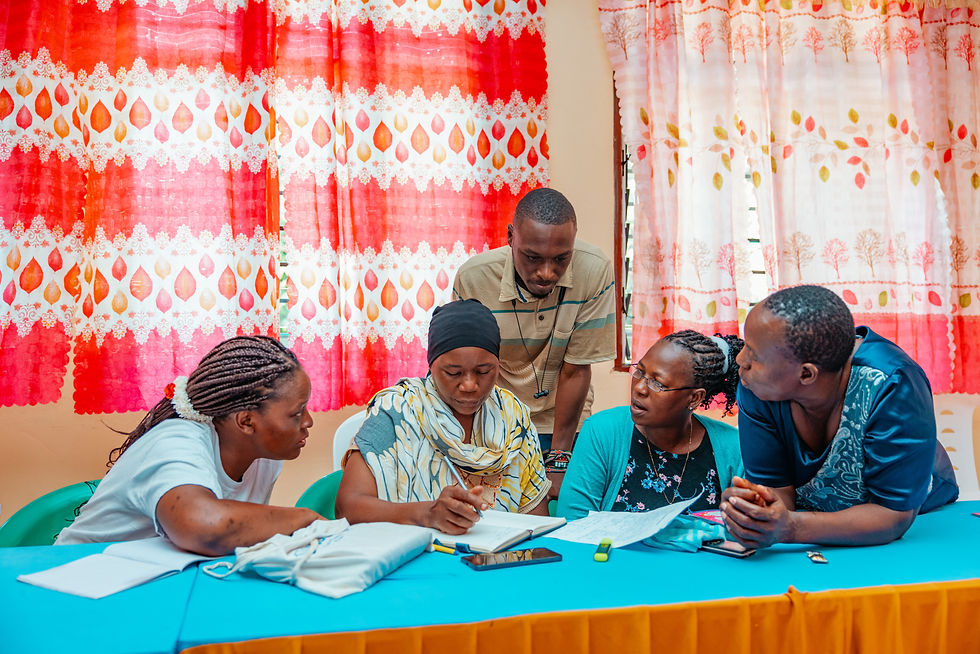
Rather than simply listening, the Mamaz worked together in groups, developing business plans and exploring their own business ideas. The conversations between the women were an important part of the process. Everyone brought different experiences to the room, creating an opportunity to learn not only from the trainers but also from one another.
Learning to see every sale differently
For Mama Ziro, one of the lessons that stood out was deceptively simple: making a sale isn't the end of the story.

Keeping records helps turn individual transactions into information that can be used to understand a business. What came in? What went out? What is working? What needs to change? These practical skills can help entrepreneurs make more informed decisions about what comes next.
For Delilah, the change was about finding confidence in communicating what she creates.

That confidence matters. A maker may know every detail of how something was created, but entrepreneurship also involves learning how to communicate its value to somebody encountering it for the first time.
For Precila, the workshop brought several of these lessons together:

Three women. Three reflections. But they point towards the same idea: craft creates the foundation. Business knowledge helps create possibilities around it.
A certificate — and a new milestone
At the end of the training, each participant received a Certificate of Completion. On paper, a certificate marks the completion of a workshop. But the real achievement isn't the piece of paper. It's what the women take away with them.
A better understanding of financial records. A business idea that has become a little clearer. Greater confidence talking to customers. A goal written down for the first time. A conversation with another Mama that sparks a completely new idea.
Learning doesn't end when a workshop does. The value comes when those lessons begin finding their way into everyday decisions.
From individual skills to stronger communities
Supporting women's entrepreneurship isn't simply about growing individual businesses. The knowledge and opportunities created through microenterprise can have a much wider reach.
When women have opportunities to develop their skills and build more resilient sources of income, the effects can extend into their households and communities. And when women share knowledge with one another, that learning has the potential to travel even further.
This is an important part of the thinking behind the Ocean Sole Mamaz. The women are skilled creators. But creativity shouldn't be where the opportunity ends. Entrepreneurship training can help provide another layer: the practical knowledge needed to think about customers, finances, planning and the future.
And that is why seeing the Mamaz gathered around tables developing their own business ideas felt significant. The ideas belonged to them. The training simply provided more tools with which to build them.

Microenterprise: five questions people are asking
The Mamaz's experience also connects to a much broader conversation about microenterprise and entrepreneurship. Below, we answer five of the questions people most frequently ask when exploring the subject.
What are the challenges of microenterprises?
Microenterprises can face challenges including access to finance, managing cash flow, keeping accurate financial records, finding and retaining customers, marketing effectively, planning for growth and responding to changes in the market.
Some of those challenges were exactly why practical skills formed such an important part of the Mamaz's training. Learning about business planning, customer development, marketing and financial literacy doesn't guarantee that running a business will be easy. What it can do is give entrepreneurs better tools for understanding challenges and making informed decisions when they arise.
Mama Ziro's lesson about financial records is a good example. Recording sales and expenses may feel like a small administrative task, but it can provide information an entrepreneur needs to understand the health of her business.
What are the 5 C's of an entrepreneur?
There isn't one universally agreed definition of the “5 C's of entrepreneurship”; different business and educational frameworks use the phrase differently. For that reason, we wouldn't want to present one particular list as an established rule.
What the Mamaz's training demonstrated is perhaps more useful than memorising a formula: entrepreneurship requires a combination of practical business knowledge, confidence, customer understanding, planning and the ability to adapt.
For Delilah, confidence in marketing her products was important. For Mama Ziro, financial record-keeping stood out. For Joyce, understanding both customers and money was key. Entrepreneurship isn't one skill. It's a collection of skills that develop through learning and experience.
What are the 7 M's of entrepreneurship?
Like the 5 C's, the “7 M's of entrepreneurship” can refer to different frameworks depending on the source, so we would avoid presenting a single list as universally accepted.
For a small entrepreneur, the more important question is what resources and knowledge are needed to turn an idea into a functioning enterprise. The Mamaz's training concentrated on practical areas they can apply directly: finances, business planning, marketing, customers and long-term sustainability. Those are the skills we can speak about with confidence because they were part of the actual training.
Why are microenterprises important?
Microenterprises can provide a way for people to turn existing skills, knowledge and ideas into income-generating activity. Their importance isn't only economic. At a community level, small enterprises can create opportunities for skills development, local exchange and greater economic participation.
For the Ocean Sole Mamaz, microenterprise offers a way of looking at craftsmanship differently. A handmade product represents creativity and skill. Entrepreneurship asks the next questions: who is the customer? What does it cost to make? How should the money be managed? How will people discover it? What could the enterprise become?
Helping women develop the knowledge to answer those questions can support the journey towards more sustainable livelihoods.
What defines a micro-enterprise?
Broadly, a microenterprise is a very small business, often operating with only an owner or a small number of workers and relatively limited capital. However, the precise legal definition varies between countries and institutions, particularly when employee numbers, turnover or assets are used to classify businesses.
What's more interesting in the context of the Ocean Sole Mamaz is what can happen at this scale. A small enterprise can begin with something very simple: one person, one skill and one idea. Business knowledge can then help that person think more deliberately about customers, finances and growth.
That is what made this training meaningful. It met creativity with practical knowledge — while leaving the women themselves in charge of where their ideas go next.
The next chapter belongs to the Mamaz

The final photograph from the training captures everyone together after the workshop. But it isn't really an ending.
The most interesting part happens afterwards: when the notebooks reopen, the lessons are tested, mistakes become new lessons and ideas begin taking shape. The journey towards entrepreneurship is built through learning, resilience, confidence and opportunity.
We are proud of every Mama who completed the training, and once again, a huge thank you to Collette, MESENow, Professor Ezenwayi, Omar and everyone involved in making this learning opportunity possible.
The Mamaz already had the creativity. Now, they have a few more tools to help decide where that creativity takes them.
If you would like to support our community programs please click the link below.


Comments